How reading is taught
Decodable books vs leveled readers: which should my child read?
Decodable books are built from sounds your child has been taught. Leveled readers are matched by difficulty. Why the difference matters for a child who guesses.
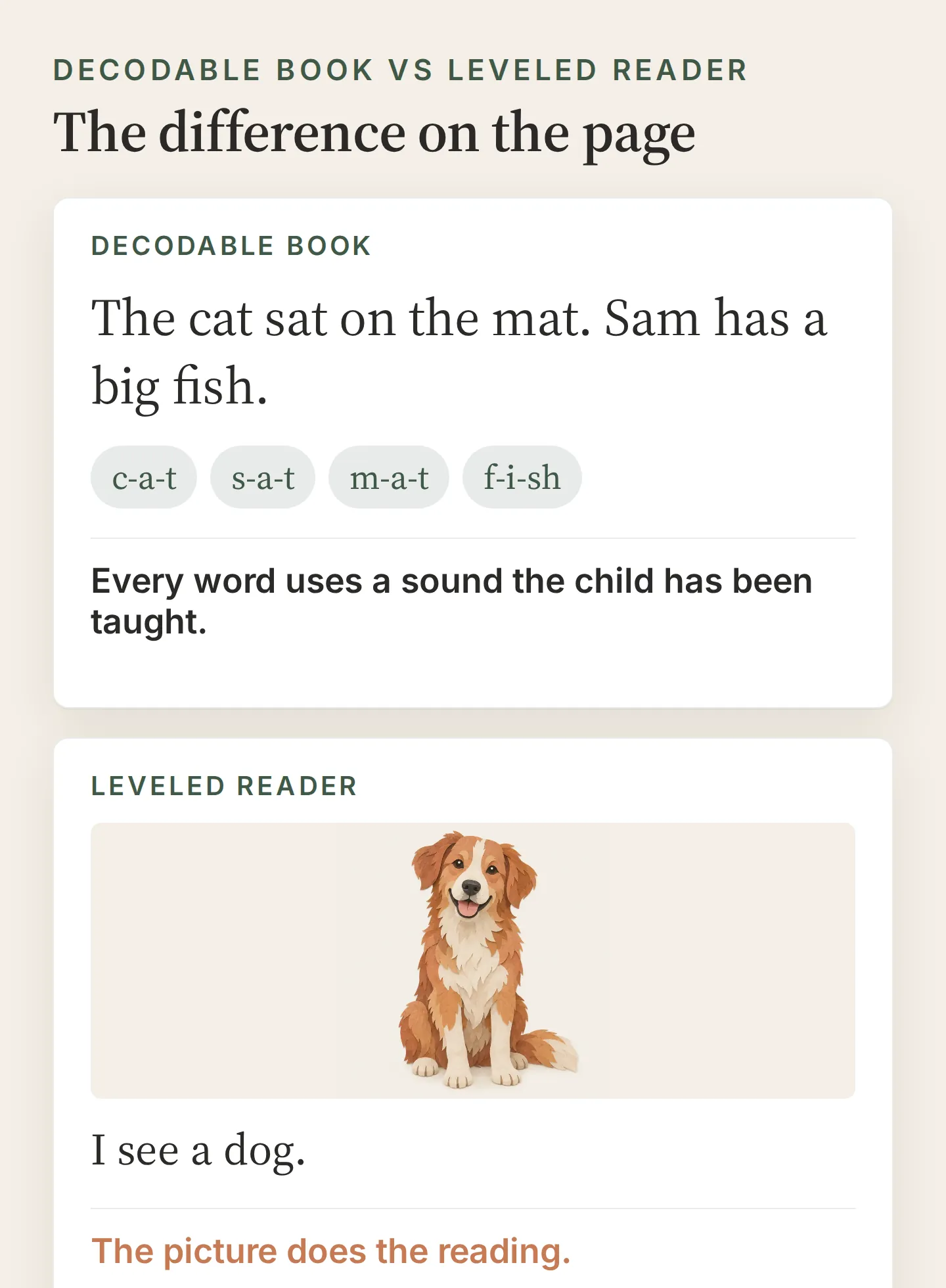
A decodable book is one your child can read by sounding out, because every word in it uses letter-sound patterns they have already been taught. A leveled reader is a book matched to your child by overall difficulty, with words they may have no way to read yet except by looking at the picture or remembering the shape. For a child who is still learning to decode, and especially for one who struggles, decodable books are the right tool. Leveled readers come back later, once sounding out is automatic.
That is the short version. Here is what each kind looks like, why the difference matters more than it seems, and what to do about the books coming home this week.
What is a decodable book?
A decodable book is written inside a limit. If your child has been taught the short vowels and the consonants, the book uses only those: The cat sat on the mat. Sam has a big fish. A few common words that cannot be sounded out yet, like the and said, are taught as wholes and used sparingly. Every other word is one your child can work out.
The limit is the point. A child who has just learned that sh is one sound gets a book full of ship, shop and fish, and gets to feel the new skill work on a real page. Nothing in the book asks them to guess, so nothing in the book teaches them to.
As the taught patterns add up, the books widen. Long vowels, then vowel teams, then longer words. By the time a child has been through a full phonics sequence, most children’s books are decodable for them, and the label stops mattering.
What is a leveled reader?
A leveled reader is a book graded by difficulty, usually with a letter on the cover: A at the start, then B, C, and on up through the alphabet. The grade takes in sentence length, vocabulary, how much the pictures help, and how predictable the text is. It does not take in which sounds the child has been taught.
At the early levels, the books lean on repetition and pictures. I see a dog. I see a cat. I see a frog. The child reads I see a from memory and names the animal from the picture. It feels like reading, and for a child who already decodes well it does no harm.
For a child who does not yet decode, the same book offers only one way through: guess. From the picture, from the first letter, from what would make sense. The book cannot be sounded out, so it teaches the child to do something else instead.
Why does the difference matter for a child who guesses?
Because guessing works, until it does not. Through kindergarten and much of first grade, pictures and patterns carry a child a long way. Somewhere around second grade the pictures thin out, the sentences stop repeating, and the words get longer. A child who has been guessing hits a wall there, and it can look sudden.
For a child with signs of dyslexia, this is often the story. Early leveled books hide the trouble, because a bright child with a good memory can pass them without decoding at all. The struggle shows up later and gets called a second-grade problem when it was there from the start.
The research points the same way. The National Reading Panel found in 2000 that explicit teaching of the sounds in words, plus systematic phonics, produced the strongest gains for beginning readers. Decodable books are where that teaching gets practiced. A 2012 review of the studies on decodable text (Cheatham and Allor) concluded that decodability is a critical feature of early reading text, because it makes children more likely to use sounding out when they read, with the quickest gains in accuracy. The International Dyslexia Association puts decodable text at the center of early practice for the same reason.
Are decodable books boring?
Some are. A book built from twelve sounds has to work hard to tell a story, and not every publisher bothers. The good ones do: a real character, a small problem, an ending. And the constraint loosens quickly. Within a few months of steady teaching, the range of words a child can decode grows fast.
Two things help. Keep reading rich books aloud to your child at any level. The vocabulary and the love of stories come from you, not from the practice book. And treat the decodable book as the reading your child does alone, ten minutes at a time, where the whole job is to make sounding out feel easy.
When do leveled readers come back?
When decoding is automatic. The sign is simple: your child meets a word they have never seen, like plank or stump, and reads it without looking at you or at the picture. Once that is true for most words, any well-written book at the right difficulty is fine, and the questions become the interesting ones. Does my child understand it, and do they want to read it.
Until then, the letter on the cover is not a measure of your child’s reading. It is a measure of the book.
What can you do this week?
- Cover the pictures. Take one of the books that came home, put your hand over the illustration, and ask your child to read the page. If the words come, the book is fine. If the reading falls apart, your child has been reading the pictures.
- Ask the teacher which decodable set goes with the phonics program. Most structured programs have one. If the answer is that the class uses leveled books only, that tells you what to add at home.
- Get a small stack of decodable books matched to the sounds your child knows. Ten minutes a day, on their own. Honey Root works the same way: every story is built from the sounds and patterns your child has already been taught, so there is nothing on the page to guess at, and when a word goes wrong it teaches the sound behind it.
Questions parents ask
- Is a decodable book the same as a phonics reader?
- Usually, yes. Publishers use both names for books whose words are limited to the letter-sound patterns a child has been taught, plus a few common words taught as wholes. The name matters less than the match. A book is only decodable for your child if it uses the sounds your child actually knows.
- The school sends home leveled books. Should I stop using them?
- No need to fight the school over it. Read them together, with you reading the parts your child cannot yet sound out, and keep a separate stack of decodable books for the reading your child does alone. What you want to avoid is your child practicing guessing every night on books that give no other way through.
- What level should my child be reading at?
- The letter on a leveled book tells you how hard the book is, not what your child can do. The more useful question is which sounds and patterns your child can read on their own. A child who can read any short-vowel word, then words with sh and ch, then words with a silent e, is making real progress whatever the letter says.
- How long does a child need decodable books?
- Until sounding out is automatic and most words come easily. For many kids that is the first year or so of learning to read. For a child who struggles, longer, and that is fine. The books get richer as the sounds add up, and the switch to ordinary books happens on its own once nothing on the page needs guessing.