How reading is taught
Why reading apps don't stick, and what to look for instead
Most reading apps move a child to the next level whether or not the last skill held. Why that fails a child who struggles, and what to look for instead.
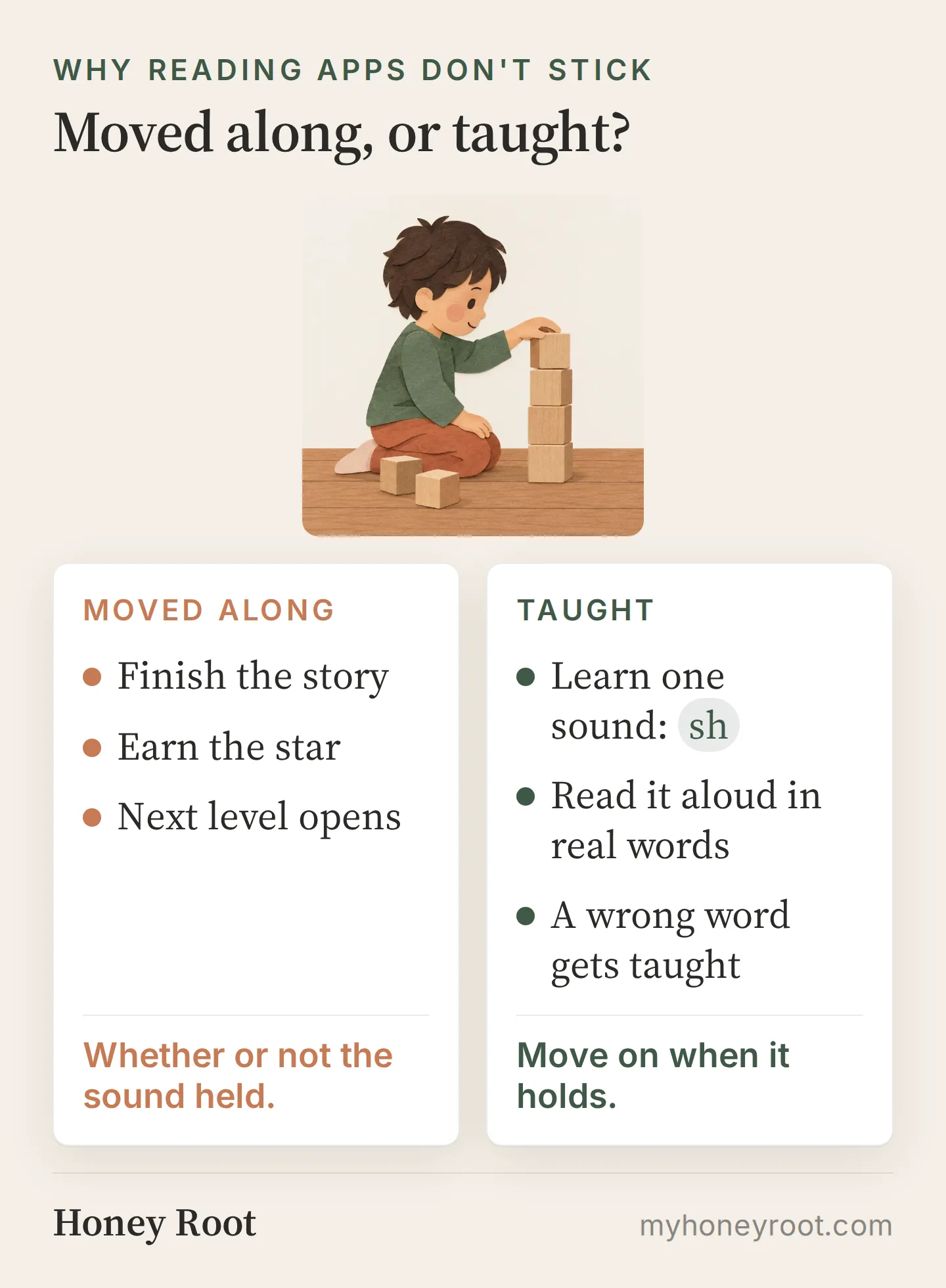
Most reading apps don’t stick because of how they decide a child is ready for more. Finish the story, earn the star, and the next level opens. Whether the skill underneath actually held rarely comes into it. A child who was already struggling ends up further along in the app and no further along on the page. What works is slower and plainer: teach one sound, have the child read real words with it out loud, teach the word that goes wrong right when it goes wrong, and move on only when the sound holds.
If you have tried two or three apps and your child still guesses at words, this is probably why. It isn’t your child, and it isn’t you.
What does “moving kids along” look like?
It looks like progress. There is a map with stops on it and a level number that goes up. Each finished activity earns something. From across the room, a parent sees a child busy and a number climbing, and it is reasonable to think the reading is climbing with it.
The trouble is what the app counts. Most count time spent and activities finished. A child who taps quickly through a story finishes it. A child who guesses the right picture three times out of four passes the check. The app has no way to tell a child who read the word from a child who got lucky, so it moves them both along.
Why does that fail a child who is already struggling?
Because reading is built in layers, and each layer rests on the one below. Short vowels come before blends, blends before sh and ch, those before the silent e in cake. A child who is shaky on short vowels and gets moved along anyway meets cake with nothing solid underneath it. So they do what struggling readers do: look at the picture, look at the first letter, and guess.
Every new level adds a layer on top of the gap. The gap does not close on its own. It gets covered over, until the pictures thin out around second grade and the guessing stops working. The International Dyslexia Association calls the answer cumulative teaching: each skill practiced and checked before the next one is built on it.
Time matters here too. In one careful study, reading help given in first and second grade produced roughly double the gains of the same help started in third (Lovett and colleagues, 2017). Months spent moving through levels without learning the sounds are months that count.
Does my child need to read out loud?
Yes, if the app is going to know anything about their reading. Many apps check reading with taps: pick the picture that matches, drag the word to the right spot. Those can be passed by elimination or by luck. Reading is looking at letters and saying the word, and the only way to check that is to hear it.
The National Reading Panel found that guided repeated oral reading, where a child reads a passage aloud more than once and gets feedback as they go, helped word recognition, fluency and comprehension. The feedback is the part that matters. Reading aloud to no one is practice at best, and practice at guessing at worst.
It also matters what your child is reading. A book whose words use only the sounds your child has been taught gives them a real way through every sentence. We wrote about that in decodable books vs leveled readers.
What should happen when a word goes wrong?
Something that teaches. In a lot of apps a wrong answer gets a buzz and a “try again,” or the app says the word and moves on. Neither tells the child what went wrong. They either guess again or wait to be told.
A better correction is small and specific. Your child reads ship as sip. Stop there. Show that s and h together make one sound, /sh/. Then let your child read ship again, on their own. That is how a good tutor does it, and it is the moment the sound has its best chance to stick.
Do points and streaks help?
They keep a child on the screen. That is a different thing from teaching them to read. A 2021 study of the top-ranked educational apps for young children, plus the ones preschoolers used most, found low marks across every measure of how children learn, and pointed to distracting sound effects, ads and gimmicky rewards as part of the reason (Meyer and colleagues).
A reward for finishing teaches a child to finish. A fast tap earns the same star as a hard-won word, and a kid who is struggling will find the fast tap. Streaks add worry about the missed day instead. If you want to reward something, reward the reading itself: a new word read on the first try, a hard page gotten through.
What should a reading app do instead?
Look for these, in roughly this order of importance.
- It moves on only when a skill holds. Not after a set number of days, and not after a set number of activities. Ask the app, or its website, how it decides.
- Your child reads real sentences out loud. Built from sounds they have been taught, so sounding out works on every word.
- A wrong word gets taught, right there. The sound behind it, then another try.
- You can see what was practiced. In plain words, like “short-a words and the sh sound,” not a level number.
- Sessions are short and happen most days. Ten minutes a day beats an hour on Saturday.
These are the same things a good reading tutor does, and they are what the structured literacy approach asks for. Honey Root is built on this list. Your child reads a story aloud, Honey Root follows along word by word, and when a word goes wrong it teaches the sound behind it and listens while your child reads it again. New sounds come only when the current one holds.
What can you do this week?
- Sit in on one session. Watch the app your child uses now, start to finish. Notice where they tap fast without looking, and where the app asks them to read a word out loud, if it ever does.
- Ask what the app says your child has learned. If the answer is a level or a number of stars, ask a harder question: which sounds can my child read now? An app that cannot answer that is not tracking it.
- Try one real word and one made-up word. Take a sound the app says your child knows, like sh. Write ship on paper, then a made-up word with the same sound, like shog. A child who reads shog is sounding out. A child who reads ship but stalls on shog may have memorized the word, and needs more time on the sound.
Questions parents ask
- Should I stop the reading app my child's school assigned?
- Usually not. The school may use it to track assignments, and a few minutes of it does no harm. Sit in on one session, see what it asks your child to do, and decide whether the real reading practice needs to happen somewhere else.
- How long before I know whether an app is helping?
- Give it a few weeks of steady use, then look away from the app. Can your child read words on paper that use the sounds the app says they have learned, including words they have never seen? That tells you more than any level or badge count.
- Is screen time bad for learning to read?
- The screen matters less than what happens on it. A child reading real sentences aloud, with someone or something listening and correcting, is doing the work of reading. A child tapping through games is mostly tapping. Keep reading books aloud to your child either way. That part no app replaces.
- Can an app take the place of a tutor or a specialist?
- Not for a child who needs one. An app can give steady practice every day, which is hard to get any other way. If your child has been evaluated and a specialist was recommended, use the app for the daily practice and keep the specialist.
- Does Honey Root use points or streaks?
- No. There are no points, streaks, clocks or leaderboards. The short game rounds are built from the sounds your child is learning, and the only prize is the word itself, which stays on a shelf your child can read back any time.