About Honey Root
How Honey Root works
What a Honey Root reading session looks like from the warmup to the note you get after, plus the games, the stories you read together, and what setup asks.
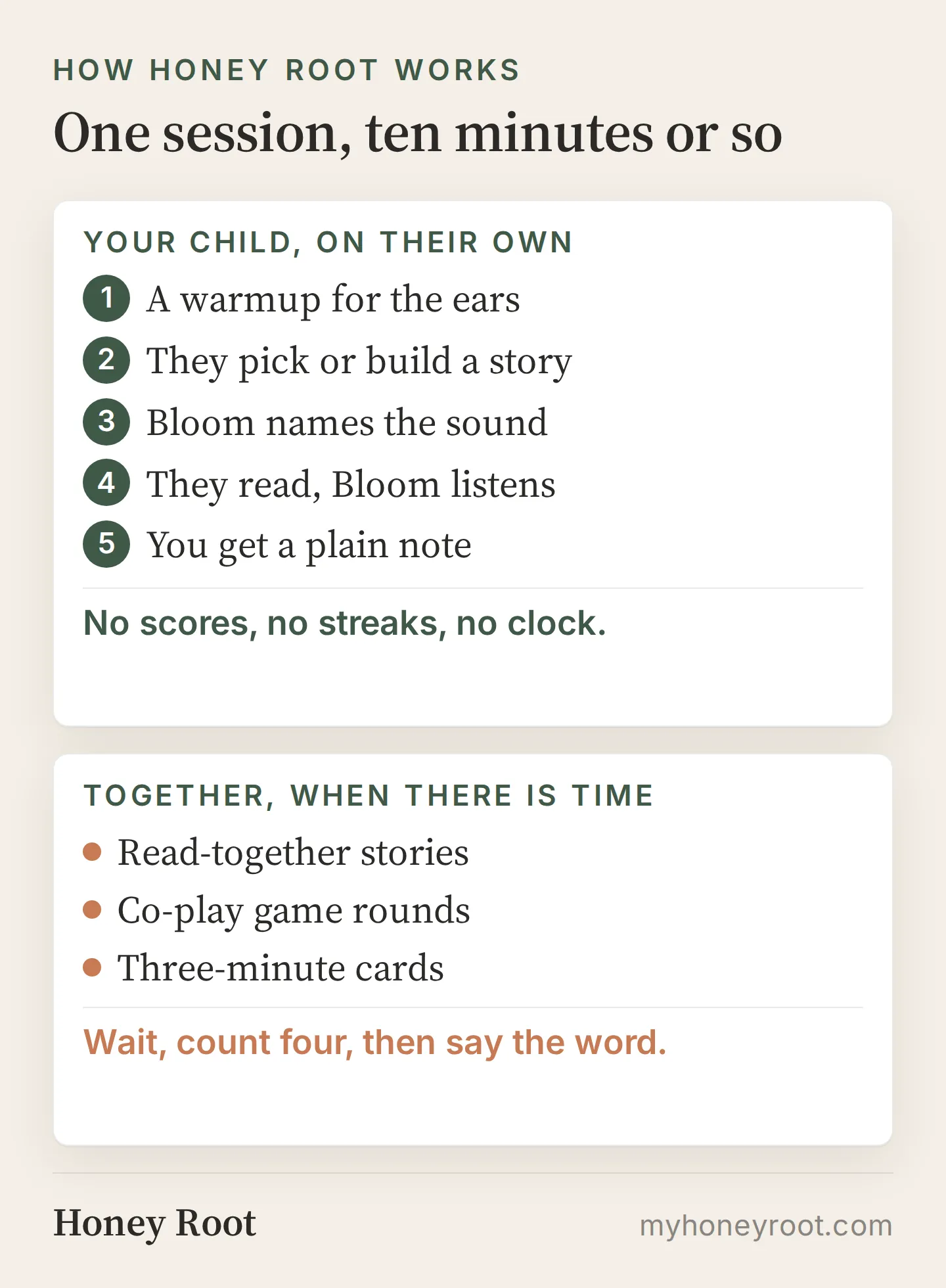
Honey Root is a reading app for kids 5 to 10 who guess at words. Your child reads a short story out loud, Bloom listens and teaches the sound behind any word that goes wrong, and you get a plain note afterward about what was practiced. A session takes ten minutes or so, and your child can run it without you.
Here is the whole thing, in the order your child meets it.
What happens in a session?
Bloom, a small friendly cactus, walks your child through each step. The first time each day, your child wakes Bloom up by talking to it, which checks that the microphone works. Nothing from that check leaves your device.
- A warmup for the ears. Two quick listening games before any letters show up: which words rhyme, what sound a word starts with, how sounds blend into a word. Hearing the sounds inside words is what reading is built on.
- A story. Your child picks one from the shelf or builds their own from a character, a place and a quest. Either way, the story uses only the sounds and word patterns your child has been taught, so it can be read by sounding out rather than guessed from a picture.
- Getting ready. Before the first page, Bloom names the sound pattern the story practices and has your child say a few of its words. Words that don’t follow the rules yet are taught whole here, so they don’t ambush your child mid-sentence.
- Reading out loud. Bloom listens word by word. It doesn’t jump in on every stumble. When a word goes wrong, Bloom stops there, teaches the sound behind it, and listens while your child reads it again. The help comes in small steps, starting with a nudge toward the first letters. Bloom only says the whole word when the smaller steps haven’t worked. If your child goes quiet, Bloom helps sooner, so nobody sits stuck on one word.
- Done. A short moment to mark the story finished, then your child can read another or head back home.
Speech recognition does the listening. It is a tool for hearing the words, and the teaching comes from the order of the lessons.
What does the note after a session say?
A few plain sentences on your dashboard: what your child practiced, one moment from the reading, and what comes next. A typical note reads like this.
Short-a words, and the sh sound. Maya read tonight’s story on her own. On ship she tried sip, was taught the sh sound, and read it right on her own. Next up: more sh words, until it holds.
When there is something worth trying together, the note says what. It has no scores and no levels. The dashboard shows which sounds your child worked on this week and how many stories they finished, and the name of the stage they are in is what they are learning, like short vowel words, never a number. A short summary of the week also arrives by email on Saturday.
What are the games for?
The games open after the day’s first story, and there are only a couple of rounds a day. Every round uses the sounds your child is learning right now.
- Word Grower: hear a word and build it from its sounds.
- Word Pantry: spell the word from memory to label a jar.
- Honey Hunt: send the bee to the flower whose word matches what you heard.
- Lantern Trail: read words out loud to light the way.
- Story Stage: read a finished story again.
There are no points, streaks, clocks or leaderboards. Games never move your child ahead by themselves. The reading does that.
What can we do together?
Honey Root is built so your child can read on their own, and so that when you have ten minutes, you have something exact to do with them.
Read-together stories. True stories, like Balto and the serum run or the girl who dug up a sea dragon. You take turns by page. Your pages read like a real book, and your child’s pages use only the sounds they’ve been taught, so their share grows as they learn. The first time, Bloom shows you the one habit that matters most: when your child gets stuck, wait. Count four in your head, then say the word, let them repeat it, and keep going.
Co-play rounds. The same games, with a part for each of you. You tap the words to hear them, and your child does the sounding out.
Three-minute cards. A card for the sound your child is working on, with what to say and when to stop. No prep, and never homework for you.
How does Honey Root decide what to teach?
Lessons follow a set order, the same idea as structured literacy: short vowel words first, then two letters that make one sound (sh, ch, th), blends, silent e, endings like -ing, vowel teams, vowels with r, and longer words built from prefixes and suffixes. Each step is practiced until it holds before the next one builds on it.
At setup you pick a starting point. Tell us the hardest sentences your child reads smoothly, say they are just starting, or let Bloom work it out. Bloom adjusts as your child reads, and you can change the starting point from your dashboard.
Honey Root is built on researched practice. There is no independent study of the app itself yet. It doesn’t diagnose dyslexia or any other reading difficulty. It finds where your child’s reading is and teaches from there.
What does setup ask of me?
All of it happens on screen. Nothing to print, sign or mail.
- Your email and a password.
- Your child’s first name or a nickname, their age and grade, what worries you about their reading, and a few interests so stories fit them.
- A starting point, as above.
- Parent consent, which children’s privacy law requires. You choose how long recordings are kept, then do a card check of about fifty cents that is refunded within a few days.
Once you are in, you set a four-digit PIN your child uses to sign in.
Honey Root is available in the United States and is opening state by state. If your state isn’t open yet, you can join the list.
What to do this week
- Set it up on the device your child already reads on, with the microphone allowed.
- Let your child run the first session alone, even if you hover in the doorway.
- Read the note that evening with your child, and try what it suggests.
- On the weekend, pick a read-together story and take turns.
Questions parents ask
- How long is a session?
- Ten minutes or so. One story is the whole unit of work, so there is no timer and nothing to finish on the clock. If your child wants another story afterward, there is a button for that.
- Can I change where my child starts?
- Yes. The starting point you picked at setup is on your dashboard, and you can change it there at any time. Bloom also adjusts as your child reads, so you don't need to get it exactly right on the first day.
- Can my child pick their own stories?
- Yes. They choose one from the shelf, or build their own from a character, a place and a quest. Either way the story uses only the sounds they have been taught, so the one they pick is one they can read.
- Why do the games wait until after reading?
- Because the reading is what moves your child forward. The games open after the day's first story and use the same sounds, which helps those sounds stick. If a hard day ends a story early, the games still open.
- What does a read-together story look like?
- A true story about a person, an animal, a sport or a big moment, told in pages you take turns reading. Your pages read like a real book. Your child's pages use only the sounds they have been taught, so their share of the story grows as they learn.