Comparing the options
Reading apps for a child with signs of dyslexia: how five compare
Nessy, Reading Eggs, Hooked on Phonics, Lexia Core5 and Honey Root side by side. What each does well, where each falls short, and how to choose.
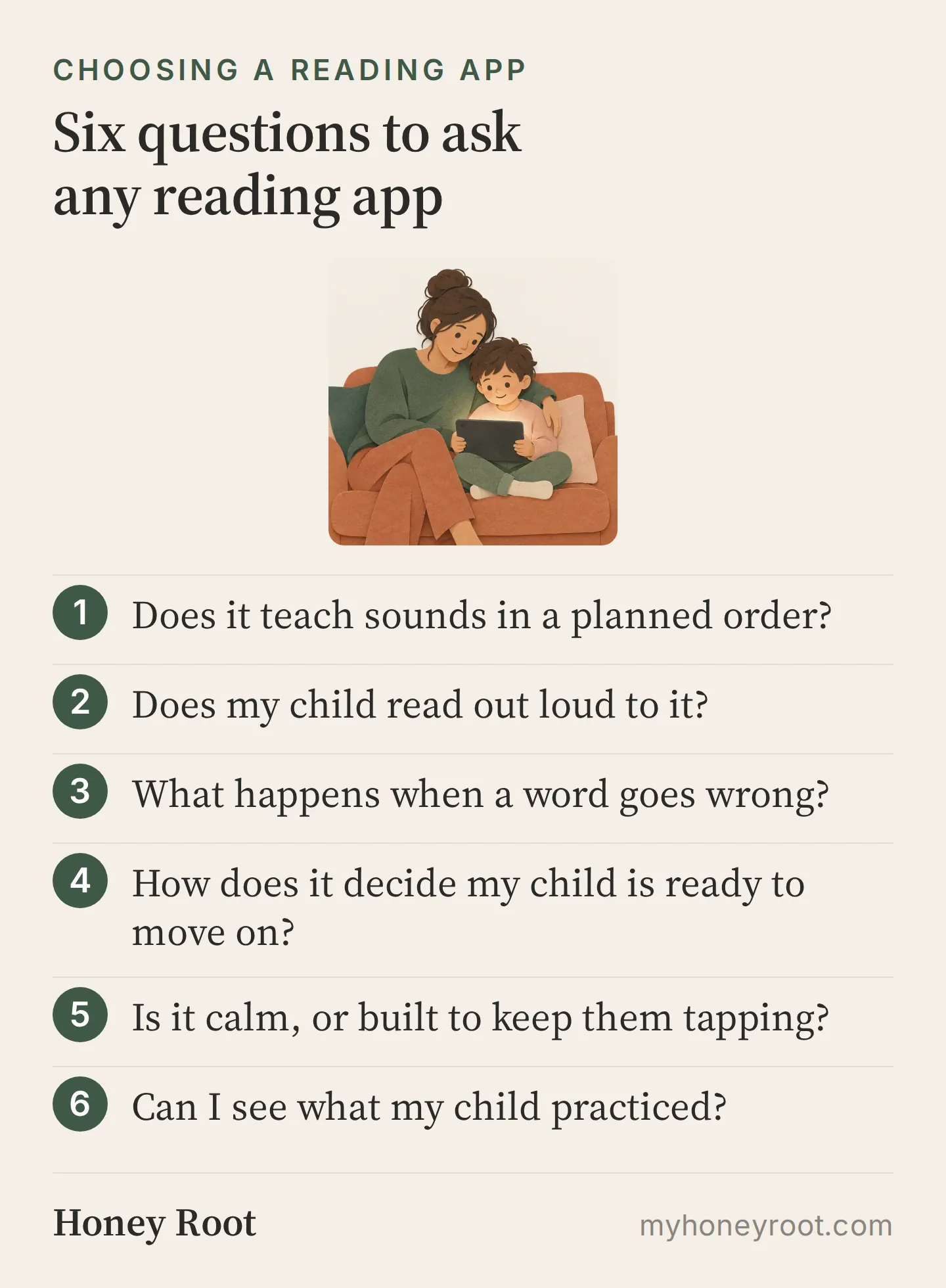
There is no single best reading app for a child with signs of dyslexia, but there are clear differences between the well-known ones. Honey Root, which we make, is the newest, and it does three things we could not find together anywhere else on this list. It listens while your child reads aloud and teaches the sound behind a word they miss. It stays calm: a short session, with no points, coins or prizes. And it has two ways in, one for your child on their own and one for the nights you can sit down together.
The others each do something well. Nessy was built for dyslexia and teaches spelling alongside reading. Lexia Core5 has the strongest independent research, and most families get it through their school. Hooked on Phonics sends real books to your door. Reading Eggs has the most content across the widest age range.
We make one of these apps, so read this knowing that. We have tried to be fair, linked our sources, and said plainly where the others are stronger. Everything below was checked in September 2026.
What should a reading app do for a child with dyslexia?
The same things good reading instruction does. Teach the sounds in a planned order. Have the child read real words and sentences, not only tap at pictures. When a word goes wrong, teach the sound behind it. Move on only when a skill holds. For a child with dyslexia, two more things matter: a calm screen where the reading is the main event, and a way for you to help that does not turn into a nightly fight. The International Dyslexia Association calls this structured literacy, and it is the standard to hold any app to. We wrote more about why so many reading apps fall short of it.
How do the five compare?
Does your child read aloud to it?
- Honey Root
- Yes. It listens word by word and teaches the sound behind a missed word.
- Nessy
- Not that we could find. Practice is on screen.
- Reading Eggs
- A one-minute recording that a grown-up scores by hand, on one plan.
- Hooked on Phonics
- Not that we could find.
- Lexia Core5
- Not that we could find.
Does it use points, coins or prizes?
- Honey Root
- None, on purpose. The prize is the word itself.
- Nessy
- Yes. Nessy nuggets to earn and trade for games and trophies.
- Reading Eggs
- Yes. Golden eggs to earn and spend in an in-app shop.
- Hooked on Phonics
- Yes. Avatar items in the app, stickers and certificates in the box.
- Lexia Core5
- Certificates as levels are passed.
Is there a way to do it together?
- Honey Root
- Yes. Stories and game rounds with a part for each of you.
- Nessy
- Not that we could find.
- Reading Eggs
- Not that we could find.
- Hooked on Phonics
- Books to read together, with parent tips.
- Lexia Core5
- Not that we could find.
Was it built for dyslexia?
- Honey Root
- Built for kids who guess at words, dyslexia or not.
- Nessy
- Yes. Developed at a dyslexia center.
- Reading Eggs
- No. A general reading program.
- Hooked on Phonics
- No. A general phonics program.
- Lexia Core5
- Structured literacy, widely used for struggling readers.
What ages is it for?
- Honey Root
- 5 to 10.
- Nessy
- 6 to 11.
- Reading Eggs
- 2 to 13, across four programs.
- Hooked on Phonics
- 3 to 8.
- Lexia Core5
- Pre-K to grade 5.
What does independent research say?
- Honey Root
- Each game is built on researched practice. No study of the app itself yet.
- Nessy
- No independent rating found.
- Reading Eggs
- Evidence for ESSA found no significant positive outcomes.
- Hooked on Phonics
- No studies met What Works Clearinghouse standards (2007).
- Lexia Core5
- Evidence for ESSA rates its evidence moderate.
What does Honey Root do differently?
Honey Root is for kids 5 to 10 who guess at words, with or without a diagnosis.
It listens while your child reads
Your child reads a real story out loud, and Honey Root follows along word by word. When a word goes wrong, it stops there, teaches the sound behind it, and listens while your child reads it again. Every story is built from sounds your child has been taught, new sounds come only when the current one holds, and you get a short note after each session saying what was practiced.
Two ways in: on their own, or together
Most nights your child runs the session alone, and it works without you sitting beside them. When you do have ten minutes, there is a second path made for the two of you. In a read-together story, you read the pages written for a grown-up, and your child reads the pages in between, built only from sounds they have been taught. In a together game round, Bloom talks to your child while you get your own notes on what to listen for. When one sound needs more practice, you get a short card with what to say and when to stop.
That side rests on one of the clearest findings in family reading research. In a review of studies with more than 1,300 families, children gained the most when parents were shown a specific skill to practice with them, more than when parents only listened to them read (Sénéchal and Young, 2008). Hooked on Phonics has books to read together too. What we could not find anywhere else on this list is a together mode that gives each of you a different job.
Calm on purpose
A session is one story, then one short game round, about ten minutes in all, and then it ends. There are no countdown timers and no sudden sound effects. Researchers who reviewed popular learning apps for young children found that flashy extras and gimmicky rewards pulled children away from the learning (Meyer and colleagues, 2021). For a child who already finds reading hard, a screen that is not competing for their attention leaves more room for the reading. There are no points or prizes either, and the next section says why.
Games built on researched practice
The games come after the story, and each one practices something with published research behind it. In Word Grower your child hears a word and builds it from its sounds. In Word Pantry they spell it from memory. A review of 53 studies found that teaching children to spell improved their reading as well as their spelling (Graham and Santangelo, 2014). To be plain about it, that is research on the kind of practice, not a study of Honey Root.
Where it falls short of the others: it is new. It has no independent study behind it yet, a smaller library than Reading Eggs, no full spelling strand like Nessy’s, and nothing past age 10. It needs a microphone and a fairly quiet room, and listening software can mishear a word now and then. It is free during early access.
Why do points and prizes matter?
Most reading apps pay children for playing: points, coins or eggs for finishing an activity, spent on avatars, trophies or more games. It looks harmless, and plenty of kids like it. We left it out on purpose, for two reasons.
It changes what the child is working for. Across 128 experiments, rewards promised for doing or finishing an activity tended to lower children’s own interest in it once the rewards stopped (Deci, Koestner and Ryan, 1999). A child reading for coins learns to want coins. And a child who finds reading hard will find the fastest way to earn them, which is rarely the slow, careful sounding out that builds the skill.
It is also a standard way to keep children on a screen. A University of Michigan study of the apps 3 to 5 year olds used found that four in five had design tricks meant to keep children playing or buying. One of them was the lure: stickers, trophies and daily rewards that pile up so a child keeps coming back (Radesky and colleagues, 2022). That study did not look at the reading apps on this page, and a reward system is not the same as a trick. The pull is the same, though, and it is worth asking what your child is coming back for.
In Honey Root the reward is the reading. A word your child builds goes on a shelf they can read back any time, and the note you get says what they read, not what they earned.
Is Nessy good for a child with dyslexia?
For many kids, yes. Nessy Reading and Spelling was developed at the Bristol Dyslexia Centre and follows a structured literacy sequence of 100 lessons, from beginning phonics to advanced vocabulary. A starting check sets your child’s first lessons, and spelling is taught alongside reading.
Where it is stronger than Honey Root: it was built for dyslexia from the start and has been in use for years. It teaches spelling as a full strand, it reaches up to age 11, and it comes with printable worksheets and card games for practice off the screen.
What to watch for: practice happens on screen. We found no mention of the app listening to your child read aloud. Kids earn “Nessy nuggets” to trade for games and trophies, which some children love and some chase instead of the reading. Nessy lists its own studies but has no rating from an independent review that we could find.
Is Reading Eggs good for dyslexia?
Reading Eggs is a large, general reading program with systematic phonics, not one designed for dyslexia. Its strength is breadth: separate programs from age 2 to 13, hundreds of lessons, thousands of books, and math on the same subscription.
Where it is stronger than Honey Root: far more content, a much wider age range, and apps for the web, iPhone, iPad and Android. If you have a preschooler and a fifth grader, one account covers both.
What to watch for: a placement quiz sets the start, then children work through lessons in sequence and earn golden eggs to spend on their avatar and in an in-app shop. For a child who is struggling, check that it is not moving faster than the skills underneath. On the evidence, Evidence for ESSA, an independent review from Johns Hopkins University, found no significant positive outcomes in the studies that qualified. The company points to a separate study that linked more use to higher test scores.
Is Hooked on Phonics good for a struggling reader?
Hooked on Phonics teaches phonics step by step for ages 3 to 8, through an app and, on the box plans, workbooks and small storybooks mailed each month. It is a general program for beginning readers, not one built for dyslexia.
Where it is stronger than Honey Root: real books in your child’s hands. The storybooks are matched to the lessons, the app works offline, and for a preschooler starting out it is a gentle, familiar way in.
What to watch for: we found no feature where your child reads aloud to the app and gets feedback. It stops at about second grade, so an older child who is behind may find it young. The What Works Clearinghouse found no studies that met its standards in 2007, so it could draw no conclusion either way.
Can I get Lexia Core5 at home?
Usually through your child’s school. Lexia Core5 is sold to schools, and many let students use their login at home. Lexia does not sell to families directly, but it names an authorized reseller for home use.
Where it is stronger than Honey Root: the research. Core5 follows a structured literacy sequence, adapts as your child works (stepping back to direct teaching when a child makes errors, moving on once they show they have it), and Evidence for ESSA rates its evidence moderate, from four studies with more than 17,000 students. For older kids, Lexia’s PowerUp program continues through grade 12.
What to watch for: its reports are built for teachers, and we could not confirm what a family sees at home. We found no feature where your child reads aloud and the app responds. If the school already has it, ask for the home login before you pay for anything.
How do you choose?
- Your child guesses at words, or busy, noisy apps wear them out. Honey Root, for the listening and the calm, with a way to read together on the nights you can.
- Your child’s school already uses Lexia or another program. Ask for the home login first. It costs you nothing and keeps home and school in step.
- Spelling is the bigger struggle, and your child is 8 or older. Look hard at Nessy.
- Your child is 3 to 5 and starting out. Hooked on Phonics, for the books.
- You want one subscription for several kids of different ages. Reading Eggs, watching the pace for the one who struggles.
What can you do this week?
- Ask the school what it uses. Email the teacher: which reading program does the class use, and can we use it at home?
- Try one app at a time, and sit in on the first session. Watch whether your child is reading words or tapping at pictures. Most of these apps have a free trial or a money-back window.
- Check the reading, not the app. After a couple of weeks, write a word with a sound the app says your child has learned, then a made-up word with the same sound, like ship and shog. If your child can read both, the sound is sticking.
Questions parents ask
- Is there an app made for dyslexia?
- Nessy is the one most clearly built for it, developed at the Bristol Dyslexia Centre in England. Lexia Core5 is widely used for struggling readers in schools. Honey Root is built for kids who guess at words, with or without a diagnosis. None of them replaces a specialist for a child who needs one.
- Does my child need a diagnosis to use one of these apps?
- No. All five can be used without one. If you are waiting on a school evaluation, the months in between are a good time to start daily practice, and nothing about using an app gets in the way of the evaluation.
- Can I use more than one?
- You can, but one used every day beats three used now and then. If your child already has Lexia or another program at school, ask for a home login first. Add a second app only if it does something the first one does not, like having your child read aloud.
- Do I have to sit with my child while they use it?
- For all five, no. Each is built for a child to use on their own. Honey Root adds a second path for when you are free, with stories and game rounds that give you a part of your own, but your child's session never depends on you being there.
- How did you check the facts on this page?
- From each company's own website, the independent reviews at Evidence for ESSA and the What Works Clearinghouse, and app store listings, in September 2026. Prices and features change, so check the current details before you buy. If something here is out of date, tell us through the contact page and we will correct it.