Deciding what to do
Waiting for a school reading evaluation: what to do this month
You asked the school to evaluate your child's reading. How the process works, what the school can't make you wait for, and what helps your child meanwhile.
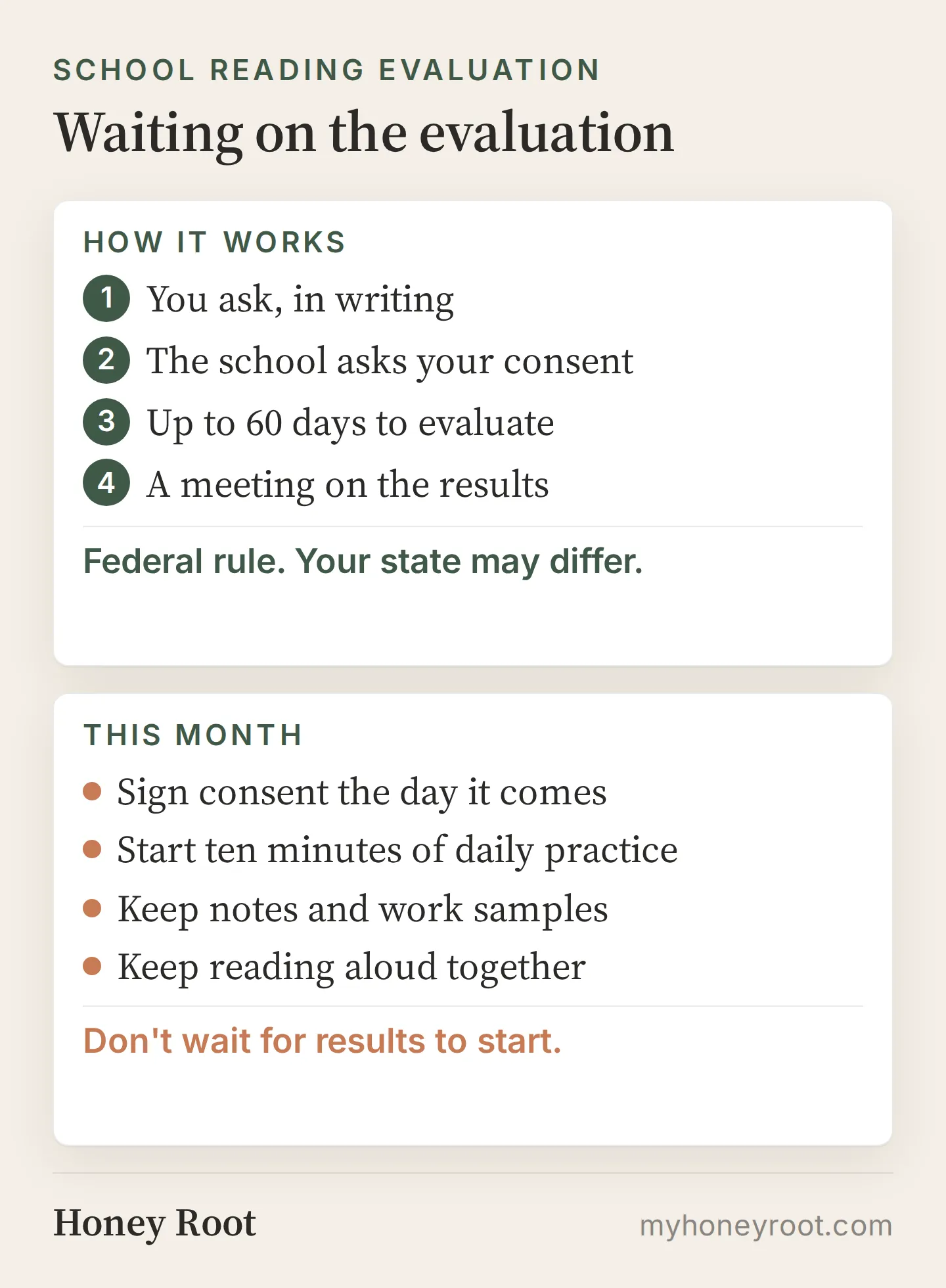
If you have asked your child’s school for a reading evaluation, two things are true at once. The school has rules it must follow, and you are not stuck waiting. Put the request in writing, sign the consent form the moment it arrives, and start daily reading practice now. The evaluation does not need your child to go without help, and help started early does the most good.
This page explains the federal rules in plain language. It is not legal advice, and your state’s rules may add to them.
How does a school reading evaluation work?
Under the federal special education law (IDEA), any parent can ask the public school to evaluate their child. The steps run roughly like this.
- You ask, in writing. Describe what you see at home and what worries you. Date it, keep a copy, and ask the school to confirm when it received it.
- The school asks for your consent. It cannot test your child without your signed permission. Federal law only says the school must ask within a reasonable time. Some states set a firm deadline for this step.
- The evaluation. Federal law gives the school 60 days from the day it receives your consent to finish, unless your state sets its own timeline.
- A meeting to go over the results. If your child qualifies, the team writes a plan for the help the school will give.
States set their own timelines, and they differ more than you would expect. Illinois gives a school 14 school days to decide whether to evaluate, then 60 school days from consent. Texas allows 15 school days to respond and 45 school days to finish. California requires an assessment plan within 15 days and a meeting within 60 days of consent. Look up your own state, or ask the school to put its timeline in writing.
What can’t the school make you wait for?
The most common delay is being told to wait for an intervention program to run its course first. Schools often call it RTI or MTSS. The US Department of Education has said plainly, since a 2011 memo, that these programs cannot be used to delay or deny an evaluation, and it repeated that guidance in 2015 and 2021. A school can run an intervention and evaluate at the same time.
If the school decides not to evaluate, it has to tell you in writing and explain why. You can challenge that decision. Every state has a free, federally funded Parent Training and Information Center that helps families with exactly this.
Dyslexia is named in the law as a kind of specific learning disability, and in 2015 the Department of Education told schools that nothing in the law stops them from using the word. There is also a second route, a Section 504 plan, which covers students whose disability substantially limits something like reading and can bring accommodations even without special education.
What does a reading evaluation look at?
A good one tests the skills underneath reading, not only whether your child can read a passage. According to the International Dyslexia Association, that usually means hearing the sounds inside words, naming familiar things quickly, reading real words and made-up ones, reading aloud with fluency, spelling and writing. It is done by people trained in education, reading, speech and language, or psychology. A medical doctor is not needed.
Made-up words matter more than they seem. A child can memorize ship, but cannot memorize shog. Reading a word they have never seen is how an evaluator sees whether your child is sounding out or guessing.
Why not wait for the results?
Because the waiting time counts. In one careful study, reading help given in first and second grade produced roughly double the gains of the same help started in third (Lovett and colleagues, 2017). A request made in October can mean results in December or later. That is a good part of a school year.
Help at home does not interfere with the evaluation. Tell the evaluator what your child has been doing and for how long. How a child responds to good teaching is part of the picture.
What can you do this month?
- Make the request official. If you asked in person or by phone, follow up in writing now. Include the date, what you have noticed, and what you and the school have already tried. Ask for a dated confirmation that it was received.
- Sign consent the day it comes. The clock does not start until the school has your signature.
- Start ten minutes of daily practice. Explicit, sounds-first practice with words and stories your child can actually decode. That is the approach called structured literacy, the kind of teaching the International Dyslexia Association recommends for children who struggle.
- Keep notes and a few samples. Once or twice a week, jot down what you see: guessing from pictures, skipping small words, a meltdown at homework. Keep a spelling test or a writing sample. Dated notes are more useful at the meeting than memories.
- Ask the teacher two questions. What help is my child getting at school right now, and how are you measuring whether it is working?
- Keep reading aloud to your child. Stories they could not read alone build the vocabulary and the love of books that practice alone does not.
Honey Root can be the daily practice in step three, with or without a diagnosis. Your child reads a story built from sounds they have been taught, Honey Root listens and teaches the sound behind a word that goes wrong, and after each session you get a short note saying what was practiced. Those notes are a dated record you can bring to the meeting.
Questions parents ask
- Should we start reading help before the evaluation?
- Yes. Nothing about the evaluation requires your child to go without help, and the months of waiting are months that count. Tell the evaluator what help your child has been getting and for how long. How a child responds to good teaching is useful information, not something that spoils the results.
- How long does a school evaluation take?
- Under federal law, the school has 60 days from the day it receives your signed consent to finish, unless your state sets its own timeline. Many states do, and some count school days rather than calendar days. The clock starts at consent, not at your first request, so sign and return the consent form as soon as it arrives.
- Can the school say no?
- It can decline, but it has to tell you in writing and explain why. It cannot refuse because your child has not finished a school intervention program first. If you disagree, you can challenge the decision, and your state's free Parent Training and Information Center can walk you through how.
- Do we need a private evaluation instead?
- No. The school's evaluation is free. A private one, from a psychologist or a university clinic, is at your own cost while you wait, and the school must consider it if you share it. A free independent evaluation at the school's expense is something you can ask for later, if you disagree with the school's results.
- Will the school use the word dyslexia?
- It can. Dyslexia is named in federal special education law as one kind of specific learning disability, and the Department of Education has said nothing in that law stops schools from using the word in evaluations or plans. Some schools still avoid it. You can ask.